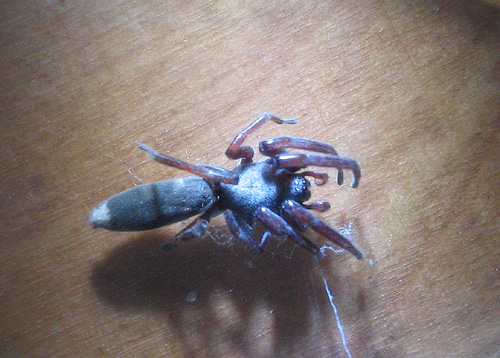
Just when you thought that Australian invasive possums in New Zealand where a pretty bad thing, one comes across this little creature (Lampona cylindrata or Lampona murina) peacefully lumbering across the board floor of our house. Although it looks pretty dangerous and awful, a closer look and some research on the web reveal that its reputation is just as bad. However it does make for an interesting read.
White tailed spiders are known to feed obligatorily on other spiders, especially the black house spider, and can be found almost anywhere in a house or other rural building. They are most likely to roam at night and can drop down from the ceiling onto beds.
And onto Wikipedia:
By comparison with other well-known Australian spiders, White-tailed spiders do not appear to be particularly numerous, but may be responsible for a disproportionately high number of spider-bites because of their habits. Unlike the Black House spider and the Red Back which are often seen in or around dwellings in a web, the White-tailed spider wanders around and may be encountered unexpectedly. Of the 130 recently-monitored cases, several spiders had been picked up off the floor accidentally by short sighted persons thinking that they were something else. More than 60% of the victims had been bitten by spiders that had got into clothing, into folded towels and into beds. In several more cases they were in shoes.
The spider often hides in clothing, especially if it is left lying around on the floor.(More bad news for me, now I know why I found it in my room).
Here is a fun Statistic taken from a very interesting 2003 paper by Geoffrey K Isbister and Michael R Gray on White-tail spider bite: a prospective study of 130 definite bites by Lampona species.
|
Activity |
Description or details of activity |
No. |
(%) |
||||||||
|
|
|||||||||||
|
Sleeping or in bed |
12 patients were sleeping at the time of the bite |
41 (32%)* |
|||||||||
|
Dressing |
Bitten immediately after dressing, or soon after clothes had been put on |
26 (20%)* |
|||||||||
|
Clothes left lying on the floor or bed |
15 (12%) |
||||||||||
|
Clothes from the cupboard |
3 (3%) |
||||||||||
|
Lying or sitting |
Patients sitting or lying on the floor, lounge or other chair; spider usually crawled on to them. |
22 (17%) |
|||||||||
|
In bath or shower |
Bitten while showering, bathing or immediately after |
19 (15%) |
|||||||||
|
On a towel when drying themselves |
14 (11%)* |
||||||||||
|
Walking (trod on spider) |
Spider on floor |
5 (4%) |
|||||||||
|
Picking up an object |
Spider mistaken for something else |
5 (4%) |
|||||||||
|
Catching spider |
3 (2%) |
||||||||||
|
Cleaning |
3 (2%) |
||||||||||
|
Other |
Driving (2), putting on shoe (2) and picking up a brick (1) |
5 (4% |
|||||||||
strangely but reassuringly no one has been bitten while reading on the loo, then again maybe these cases are hidden in the „bath or shower“ segment because of the shame…
and now for some biology:
Lampona cylindrata was first recorded in Nelson in 1913, while L. murina has been known in the North Island for at least 100 years. White-tailed spider measure up to 18mm long, males up to 12mm. They live in gardens and houses, beneath bark and rocks, in leaf litter and so on. They are also able to walk on glass, due to hairs on the end of their legs. Most active at night, they are different from most arachnids because they only hunt for other spiders. Their favoured prey is the Black House Spider. A large White-tailed Spider is suspected to have wiped out every spider within a storage shed over a period of many months (so we may keep them after all).  I guess I will go spider hunting now and try to get rid of all the other arachnid inhabitants of 10 Hallam Street to deprive this little fellow of its primary cause to visit our house. Then again, I might just catch them with the snappy and move them to the guest room ;-). And I will check my shoes in the morning from now on I guess.
For the paper on White Tail Spider bites:
http://www.mja.com.au/public/issues/179_04_180803/isb10785_fm.html